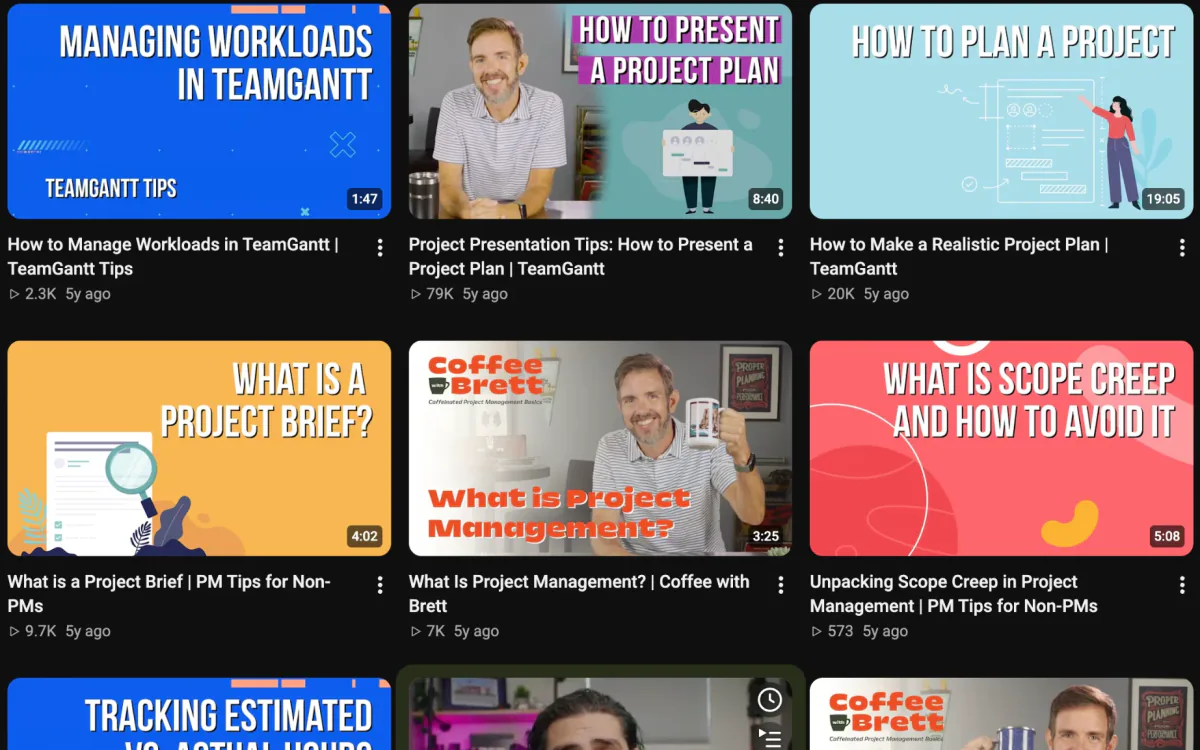
Context
When I joined TeamGantt in 2014, its YouTube channel had a few unrelated videos and no plan for what came next. TeamGantt is a project management SaaS company whose traffic was almost all organic. YouTube is the second-largest search engine after Google, so a channel without a plan meant search demand going unanswered.
Strategy
I learned the product and the business first, then built the channel in two stages.
- Support videos. Short videos showing features in action, replacing static screenshots in the support docs. For example, How to Use Gantt Chart Dependencies.
- Marketing videos. Once the support library was mostly complete, I moved to videos aimed at what people were searching for on YouTube. For example, How to Plan a Software Project: Template.
Support videos showed the product's value to people already using it. Marketing videos put TeamGantt in front of people searching for help with the problems it solves.
Keyword research
Each marketing video started with keyword research. I used keyword tools to find topics with existing search volume, so every video answered demand that was already there instead of hoping to create it. Knowing the product and its customers kept those topics close to what people actually needed.
Execution
I produced the videos end to end, from concept and scripting through filming, editing and publishing: more than 300 in all, about 285 of them on YouTube.
Two series ran alongside the rest. Coffee with Brett was a weekly YouTube series with project management expert Brett Harned. Brett wrote each episode and filmed in his home office; I set him up to film remotely, then edited and published every episode. I also edited and produced the Time Limit Podcast.
Measurement
I tracked performance in YouTube Analytics and Search Console. The harder question was whether video viewers became customers. Following a viewer from a YouTube video to a trial signup and purchase proved close to impossible.
So I built cohorts in Amplitude of users whose referrer was YouTube and compared them with users who came from Google. It isn't proof that video caused the difference, since people who watch a product video may already be more interested. But it was a fair, repeatable signal that the channel was bringing in the right people.